
Profile

Vincent Njar
Professor
Njar Group (240) 314-6448 vnjar@som.umaryland.eduDr. Vincent Njar has a long-standing interest in the rational discovery and development of small molecules as anti-cancer agents. He is a leading medicinal chemist and oncopharmacologist who has made significant discoveries in the development of novel small molecules with potential for the treatment of a variety of cancers – in particular, breast, prostate, and pancreatic cancers. Dr. Njar invented novel chemical reactions for the synthesis of novel inhibitors of a number of important anti-cancer targets. He is perhaps best known for his development of RAMBAs – retinoic acid metabolism blocking agents, and the molecule Galeterone, which is commercially available as a unique research reagent.
CURRENT RESEARCH
Novel RAMBA Retanamides
RAMBAs work by inhibiting an enzyme called all-trans retinoic acid (ATRA) metabolism enzyme (also known as CYP26). Some of the Njar group’s original RAMBAs compounds are potent inhibitors of breast and prostate cancer cell growth in vitro, and strong inhibitors of breast and prostate cancer tumors in animal xenograft models.
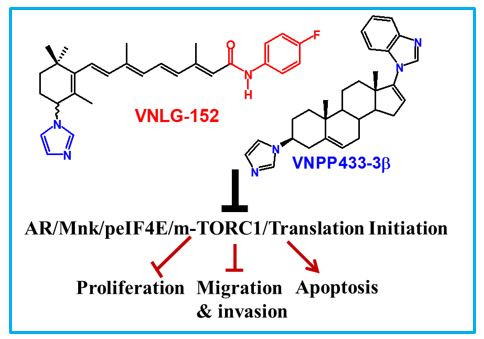 In ongoing studies, the Njar lab has discovered that novel retinamides (NRs) also antagonize transactivation of the androgen receptor (AR), and degrade the full-length and splice variant ARs in human prostate cancer cell lines. In addition, the NRs exquisitely cause degradation of MAP kinase-interacting kinases (Mnk1 and 2). This blocks initiation of eukaryotic translation initiation factor 4E (eIF4E) cap-dependent translation in both human breast and prostate cancer cell lines, promoting apoptosis and impeding cell growth, cell proliferation, and matrix invasion of breast and prostate cancer cell lines. To the best of the lab’s knowledge, its NRs are the first Mnk1/2 degraders known, making them strong candidates for development as novel anti-breast/prostate cancer therapeutics. The Njar lab’s lead Mnk1/2 degrader is called VNLG-152. Further development of these agents is ongoing in collaboration with Isoprene Pharmaceuticals, Inc., a small business founded by Dr. Njar in July 2018.
Next-Generation Galeterone Analogs
In collaboration with the late Dr. Angela Brodie, internationally renowned breast cancer researcher, Njar developed some of the most potent known inhibitors of prostate cancer target protein CYP17. The lead clinical candidate, Galeterone (formerly called VN/124-1 or TOK-001), successfully advanced through Phase I and II studies under an exclusive license by the University of Maryland, Baltimore to Tokai Pharmaceuticals, Inc. Galeterone was well tolerated, with promising clinical activity in men with castration-resistant prostate cancer. However, the Phase III trial, ARMOR3-SV, was unsuccessful; efforts to rescue Galeterone are ongoing.
Efforts in the Njar Lab are ongoing to discover and develop next-generation Galeterone analogs (NGGAs). Njar’s group has demonstrated that Galeterone and NGGAs also degrade Mnk1/2, causing inhibition of tumor growth, metastasis, and treatment resistance in various cancers. Gratifyingly, the lead NGGAs, also called Galnex small-molecules, have superior efficacies and pharmaceutical properties compared to Galeterone. The lab’s lead Galnex is called VNPP433-3β.
Publications
- Correction: Maranto et al. Prospects for Clinical Development of Stat5 Inhibitor IST5-002: High Transcriptomic Specificity in Prostate Cancer and Low Toxicity In Vivo. Cancers 2020, 12, 3412.
- Thermal proteome profiling and proteome analysis using high-definition mass spectrometry demonstrate modulation of cholesterol biosynthesis by next-generation galeterone analog VNPP433-3β in castration-resistant prostate cancer.
- VNLG-152R and its deuterated analogs potently inhibit/repress triple/quadruple negative breast cancer of diverse racial origins in vitro and in vivo by upregulating E3 Ligase Synoviolin 1 (SYVN1) and inducing proteasomal degradation of MNK1/2.
- Salinization Dramatically Enhance the Anti-Prostate Cancer Efficacies of AR/AR-V7 and Mnk1/2 Molecular Glue Degraders, Galeterone and VNPP433-3β Which Outperform Docetaxel and Enzalutamide in CRPC CWR22Rv1 Xenograft Mouse Model.
- Targeted Degradation of Androgen Receptor by VNPP433-3β in Castration-Resistant Prostate Cancer Cells Implicates Interaction with E3 Ligase MDM2 Resulting in Ubiquitin-Proteasomal Degradation.
- Murine Toxicology and Pharmacokinetics of Lead Next Generation Galeterone Analog, VNPP433-3β.
- Novel AR/AR-V7 and Mnk1/2 Degrader, VNPP433-3β: Molecular Mechanisms of Action and Efficacy in AR-Overexpressing Castration Resistant Prostate Cancer In Vitro and In Vivo Models.
- Large-scale synthesis of galeterone and lead next generation galeterone analog VNPP433-3β.
- Novel deuterated Mnk1/2 protein degrader VNLG-152R analogs: Synthesis, In vitro Anti-TNBC activities and pharmacokinetics in mice.
- Transcriptome profiling reveals that VNPP433-3β, the lead next-generation galeterone analog inhibits prostate cancer stem cells by downregulating epithelial-mesenchymal transition and stem cell markers.
- Galeterone and The Next Generation Galeterone Analogs, VNPP414 and VNPP433-3β Exert Potent Therapeutic Effects in Castration-/Drug-Resistant Prostate Cancer Preclinical Models In Vitro and In Vivo.
- A Quality Improvement Approach to Increase Exercise Assessment in Survivors of Childhood Leukemia.
- The Novel Mnk1/2 Degrader and Apoptosis Inducer VNLG-152 Potently Inhibits TNBC Tumor Growth and Metastasis.
- Structure of the Fc fragment of the NIST reference antibody RM8671.
- Submultiple Data Collection to Explore Spectroscopic Instrument Instabilities Shows that Much of the "Noise" is not Stochastic.
- Quantitative analysis of the impact of a human pathogenic mutation on the CCT5 chaperonin subunit using a proxy archaeal ortholog.
- Characterization of the NISTmAb Reference Material using small-angle scattering and molecular simulation : Part I: Dilute protein solutions.
- The retinamide VNLG-152 inhibits f-AR/AR-V7 and MNK-eIF4E signaling pathways to suppress EMT and castration-resistant prostate cancer xenograft growth.
- Novel galeterone analogs act independently of AR and AR-V7 for the activation of the unfolded protein response and induction of apoptosis in the CWR22Rv1 prostate cancer cell model.
- Short-chained oligo(ethylene oxide)-functionalized gold nanoparticles: realization of significant protein resistance.
- Biophysical characterization and structure of the Fab fragment from the NIST reference antibody, RM 8671.
- Androgen receptor antagonism and impact on inhibitors of androgen synthesis in prostate cancer therapy.
- Galeterone and its analogs inhibit Mnk-eIF4E axis, synergize with gemcitabine, impede pancreatic cancer cell migration, invasion and proliferation and inhibit tumor growth in mice.
- Targeting of protein translation as a new treatment paradigm for prostate cancer.
- Fast formation of low-defect-density tethered bilayers by fusion of multilamellar vesicles.
- Galeterone and VNPT55 disrupt Mnk-eIF4E to inhibit prostate cancer cell migration and invasion.
- Dissecting major signaling pathways in prostate cancer development and progression: Mechanisms and novel therapeutic targets.
- Identification of Novel Steroidal Androgen Receptor Degrading Agents Inspired by Galeterone 3β-Imidazole Carbamate.
- Letter to the editor.
- Guidelines for the use and interpretation of assays for monitoring autophagy (3rd edition).
- Stray light correction in the optical spectroscopy of crystals.
- Galeterone and VNPT55 induce proteasomal degradation of AR/AR-V7, induce significant apoptosis via cytochrome c release and suppress growth of castration resistant prostate cancer xenografts in vivo.
- Structure-Based Screen Identifies a Potent Small Molecule Inhibitor of Stat5a/b with Therapeutic Potential for Prostate Cancer and Chronic Myeloid Leukemia.
- Dithiol-based modification of poly(dopamine): enabling protein resistance via short-chain ethylene oxide oligomers.
- Novel C-4 heteroaryl 13-cis-retinamide Mnk/AR degrading agents inhibit cell proliferation and migration and induce apoptosis in human breast and prostate cancer cells and suppress growth of MDA-MB-231 human breast and CWR22Rv1 human prostate tumor xenografts in mice.
- Simultaneous targeting of androgen receptor (AR) and MAPK-interacting kinases (MNKs) by novel retinamides inhibits growth of human prostate cancer cell lines.
- Discovery and development of Galeterone (TOK-001 or VN/124-1) for the treatment of all stages of prostate cancer.
- Structure and function of the membrane anchoring self-assembled monolayers.
- Membrane protein resistance of oligo(ethylene oxide) self-assembled monolayers.
- VN/14-1 induces ER stress and autophagy in HP-LTLC human breast cancer cells and has excellent oral pharmacokinetic profile in female Sprague Dawley rats.
- First MNKs degrading agents block phosphorylation of eIF4E, induce apoptosis, inhibit cell growth, migration and invasion in triple negative and Her2-overexpressing breast cancer cell lines.
- Reconstitution of cholesterol-dependent vaginolysin into tethered phospholipid bilayers: implications for bioanalysis.
- Structure and properties of tethered bilayer lipid membranes with unsaturated anchor molecules.
- Systematic structure modifications of multitarget prostate cancer drug candidate galeterone to produce novel androgen receptor down-regulating agents as an approach to treatment of advanced prostate cancer.
- Modification of tethered bilayers by phospholipid exchange with vesicles.
- A generalized strategy for immobilizing uniformly oriented membrane proteins at solid interfaces.
- Further studies with isolated absolute infrared spectra of bacteriorhodopsin photocycle intermediates: conformational changes and possible role of a new proton-binding center.
- A new simple and high-yield synthesis of 5α-dihydrotestosterone (DHT), a potent androgen receptor agonist.
- The combination of the histone deacetylase inhibitor vorinostat and synthetic triterpenoids reduces tumorigenesis in mouse models of cancer.
- X-ray crystal structure of the streptococcal specific phage lysin PlyC.
- Murine toxicology and pharmacokinetics evaluation of retinoic acid metabolism blocking agent (RAMBA), VN/12-1.
- On the need for an international effort to capture, share and use crystallization screening data.
- Autophagy inhibition synergistically enhances anticancer efficacy of RAMBA, VN/12-1 in SKBR-3 cells, and tumor xenografts.
- First chemical feature-based pharmacophore modeling of potent retinoidal retinoic acid metabolism blocking agents (RAMBAs): identification of novel RAMBA scaffolds.
- New insights into the androgen-targeted therapies and epigenetic therapies in prostate cancer.
- Solution NMR evidence for symmetry in functionally or crystallographically asymmetric homodimers.
- Infrared and visible absolute and difference spectra of bacteriorhodopsin photocycle intermediates.
- Anti-tumor effects of a novel retinoic acid metabolism blocking agent VN/14-1 in the N-methyl-N-nitrosourea-induced rat mammary carcinoma model and its effects on the uterus.
- Synthesis and biological evaluations of putative metabolically stable analogs of VN/124-1 (TOK-001): head to head anti-tumor efficacy evaluation of VN/124-1 (TOK-001) and abiraterone in LAPC-4 human prostate cancer xenograft model.
- Novel, potent anti-androgens of therapeutic potential: recent advances and promising developments.
- Active-site structure of class IV adenylyl cyclase and transphyletic mechanism.
- CYP17 inhibitors for prostate cancer therapy.
- In-situ characterization of self-assembled monolayers of water-soluble oligo(ethylene oxide) compounds.
- Formation and finite element analysis of tethered bilayer lipid structures.
- Targeting drug-metabolizing enzymes for effective chemoprevention and chemotherapy.
- Protein Crystal Engineering of YpAC-IV using the Strategy of Excess Charge Reduction.
- In-plane homogeneity and lipid dynamics in tethered bilayer lipid membranes (tBLMs).
- 4-Pregnen-21-ol-3,20-dione-21-(4-bromobenzenesulfonate) (NSC 88915) and related novel steroid derivatives as tyrosyl-DNA phosphodiesterase (Tdp1) inhibitors.
- Promise and challenges in drug discovery and development of hybrid anticancer drugs.
- Quantitative infrared spectroscopy of formalin-fixed, paraffin-embedded tissue specimens: paraffin wax removal with organic solvents.
- Structure of a switchable subtilisin complexed with a substrate and with the activator azide.
- A new lipid anchor for sparsely tethered bilayer lipid membranes.
- Mechanism of formation of vesicle fused phospholipid monolayers on alkanethiol self-assembled monolayer supports.
- Tertiary structure changes in albumin upon surface adsorption observed via fourier transform infrared spectroscopy.
- Oligo(ethylene oxide) self-assembled monolayers with self-limiting packing densities for the inhibition of nonspecific protein adsorption.
- Infrared techniques for quantifying protein structural stability.
- Structure of functional Staphylococcus aureus alpha-hemolysin channels in tethered bilayer lipid membranes.
- Profound asymmetry in the structure of the cAMP-free cAMP Receptor Protein (CRP) from Mycobacterium tuberculosis.
- The Coffey Lecture: steroidogenic enzyme inhibitors and hormone dependent cancer.
- Molecular dynamics study of surface-tethered S(CH2CH2O)6CH3: helix formation and thermal disorder.
- 17alpha-Hydroxylase/17,20 lyase inhibitor VN/124-1 inhibits growth of androgen-independent prostate cancer cells via induction of the endoplasmic reticulum stress response.
- Androgen receptor inactivation contributes to antitumor efficacy of 17{alpha}-hydroxylase/17,20-lyase inhibitor 3beta-hydroxy-17-(1H-benzimidazole-1-yl)androsta-5,16-diene in prostate cancer.
- Synthesis of novel C17 steroidal carbamates. Studies on CYP17 action, androgen receptor binding and function, and prostate cancer cell growth.
- Design, synthesis, and evaluation of novel mutual prodrugs (hybrid drugs) of all-trans-retinoic acid and histone deacetylase inhibitors with enhanced anticancer activities in breast and prostate cancer cells in vitro.
- Soluble amyloid beta-oligomers affect dielectric membrane properties by bilayer insertion and domain formation: implications for cell toxicity.
- Electrogenic proton-pumping capabilities of the m-fast and m-slow photocycles of bacteriorhodopsin.
- The ability of actinic light to modify the bacteriorhodopsin photocycle revisited: heterogeneity vs photocooperativity.
- Potent anti-prostate cancer agents derived from a novel androgen receptor down-regulating agent.
- Synergistic effect of a novel antiandrogen, VN/124-1, and signal transduction inhibitors in prostate cancer progression to hormone independence in vitro.
- Self-assembled monolayers of an oligo(ethylene oxide) disulfide and its corresponding thiol assembled from water: characterization and protein resistance.
- Improved synthesis of histone deacetylase inhibitors (HDIs) (MS-275 and CI-994) and inhibitory effects of HDIs alone or in combination with RAMBAs or retinoids on growth of human LNCaP prostate cancer cells and tumor xenografts.
- Synthesis and evaluation of novel 17-indazole androstene derivatives designed as CYP17 inhibitors.
- Targeting cytochrome P450 enzymes: a new approach in anti-cancer drug development.
- Competitive antagonism between the nicotinic allosteric potentiating ligand galantamine and kynurenic acid at alpha7* nicotinic receptors.
- First pharmacophore-based identification of androgen receptor down-regulating agents: discovery of potent anti-prostate cancer agents.
- Murine toxicology and pharmacokinetics of novel retinoic acid metabolism blocking agents.
- Molecular-scale structural and functional characterization of sparsely tethered bilayer lipid membranes.
- Effects of novel retinoic acid metabolism blocking agent (VN/14-1) on letrozole-insensitive breast cancer cells.
- Regulation of androgen receptor activity by tyrosine phosphorylation.
- Retinoids in clinical use.
- Enzyme activity to augment the characterization of tethered bilayer membranes.
- Retinoic acid metabolism blocking agents (RAMBAs) for treatment of cancer and dermatological diseases.
- Osteoblast cell membrane hybrid bilayers for studying cell-cell interactions.
- Control of intracellular trafficking of ICAM-1-targeted nanocarriers by endothelial Na+/H+ exchanger proteins.
- Development of surface-based assays for transmembrane proteins: selective immobilization of functional CCR5, a G protein-coupled receptor.
- Lysosomal enzyme delivery by ICAM-1-targeted nanocarriers bypassing glycosylation- and clathrin-dependent endocytosis.
- A new simple and high-yield synthesis of suberoylanilide hydroxamic acid and its inhibitory effect alone or in combination with retinoids on proliferation of human prostate cancer cells.
- Novel C-17-heteroaryl steroidal CYP17 inhibitors/antiandrogens: synthesis, in vitro biological activity, pharmacokinetics, and antitumor activity in the LAPC4 human prostate cancer xenograft model.
- Isostructural self-assembled monolayers. 2. Methyl 1-(3-mercaptopropyl)-oligo(ethylene oxide)s.
- Novel retinoic acid metabolism blocking agents endowed with multiple biological activities are efficient growth inhibitors of human breast and prostate cancer cells in vitro and a human breast tumor xenograft in nude mice.
- Potent CYP17 inhibitors: improved syntheses, pharmacokinetics and anti-tumor activity in the LNCaP human prostate cancer model.
- Control of protein adsorption: molecular level structural and spatial variables.
- Quantification of a novel retinoic acid metabolism inhibitor, 4-(1H-imidazol-1-yl)retinoic acid (VN/14-1RA) and other retinoids in rat plasma by liquid chromatography with diode-array detection.
- ICAM-1 recycling in endothelial cells: a novel pathway for sustained intracellular delivery and prolonged effects of drugs.
- Endothelial endocytic pathways: gates for vascular drug delivery.
- Surface-plasmon-resonance-enhanced cavity ring-down detection.
- Characterization of endothelial internalization and targeting of antibody-enzyme conjugates in cell cultures and in laboratory animals.
- Slow intracellular trafficking of catalase nanoparticles targeted to ICAM-1 protects endothelial cells from oxidative stress.
- Three dimensional pharmacophore modeling of human CYP17 inhibitors. Potential agents for prostate cancer therapy.
- Pharmacokinetics of novel inhibitors of androgen synthesis after intravenous administration in mice.
- Immunotargeting of catalase to the pulmonary endothelium alleviates oxidative stress and reduces acute lung transplantation injury.
- A novel endocytic pathway induced by clustering endothelial ICAM-1 or PECAM-1.
- ICAM-directed vascular immunotargeting of antithrombotic agents to the endothelial luminal surface.