Breakthrough Study Advances Quest for a First Hepatitis C Vaccine
Tue, Mar 31, 2026
A collaborative team of scientists, including researchers from the Institute for Bioscience and Biotechnology Research (IBBR), has made significant strides in uncovering new insights that could help the development of an effective vaccine against Hepatitis C (HCV). HCV is a serious viral infection known as the “silent epidemic” that can lead to chronic liver disease and cancer and continues to infect approximately 1 million people each year. Yet, there is still no vaccine.
In a study entitled “Native-like soluble E1E2 glycoprotein heterodimers on self-assembling protein nanoparticles for hepatitis C virus vaccine design,” published in Nature Communications, researchers reveal a new approach for engineering and displaying HCV surface proteins on nanoparticles to enhance immune responses. “This represents a significant advancement in our HCV vaccine efforts”, says Dr. Thomas Fuerst, HCV vaccine program director. “The E1E2 glycoprotein is not very immunogenic and the increased valency of E1E2 heterodimers on nanoparticles is necessary to improve the overall immune response.”
HCV’s surface glycoproteins are named E1 and E2 and have historically been difficult vaccine targets due to their structure, mutability, and instability. In earlier work, detailed in the study “Structure of engineered hepatitis C virus E1E2 ectodomain in complex with neutralizing antibodies,” researchers engineered a stabilized, soluble form of the E1E2 complex. Through various advanced structural techniques, their work provided a blueprint for determining the structure of the viral complex. This identified the protein complex as a promising vaccine candidate, and it is amenable to conventional biomanufacturing platforms, such as CHO cells, for advanced development work.
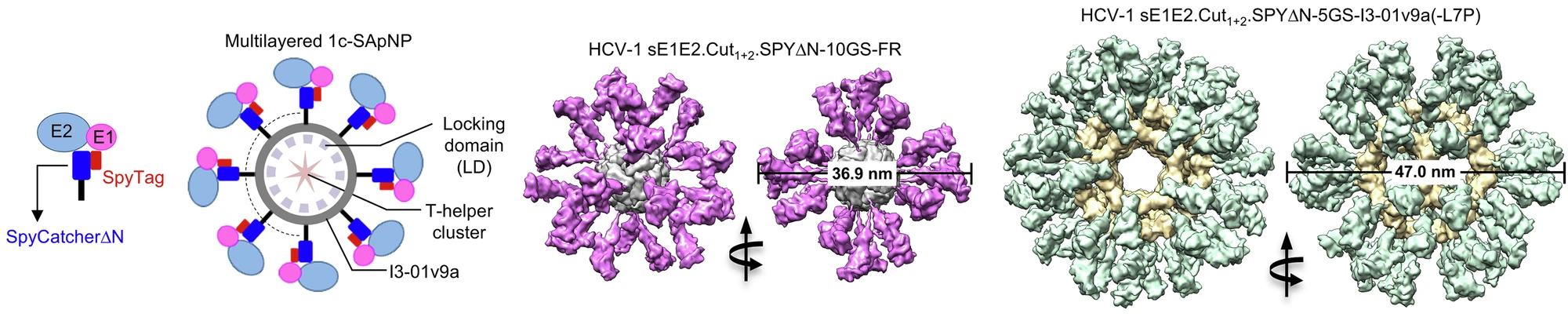
Upon this foundation, the new published study focused on how to turn this protein complex into a more effective vaccine component; they spearheaded design of an E1E2 antigen that can be efficiently incorporated into a nanoparticle-based vaccine. The researchers engineered a stable, native-like version of the E1E2 complex and incorporated a “tag” system to attach them to self-assembling microscopic particles, termed nanoparticles. Nanoparticles act like tiny scaffolds that can hold and present many copies of the viral protein at once. The presentation of many viral copies helps the immune system to better recognize the foreign antigen and respond more strongly. They then tested these vaccine candidates both in the lab and through animal studies to assess the vaccine’s stability and ability to induce immune responses.
Together, these findings highlight the team’s continued progress in overcoming longstanding challenges in designing an effective vaccine capable of preventing Hepatitis C worldwide.