
Profile

Ella Mihailescu
Associate Research Professor
Mihailescu Group (240) 314-6123 ella11@umd.eduElla Mihailescu’s laboratory develops biophysical methods to examine structural interactions of membrane proteins (MP), membrane-active peptides (MAP), and lipophilic drug molecules with lipid membranes. A major effort in the Mihailescu laboratory is directed toward advancing automation and precision measurements for studies of MAPs in engineered lipid platforms.
CURRENT RESEARCH
Surface Sensitive, Bilayer Techniques for Studies of Membrane-Active Peptides
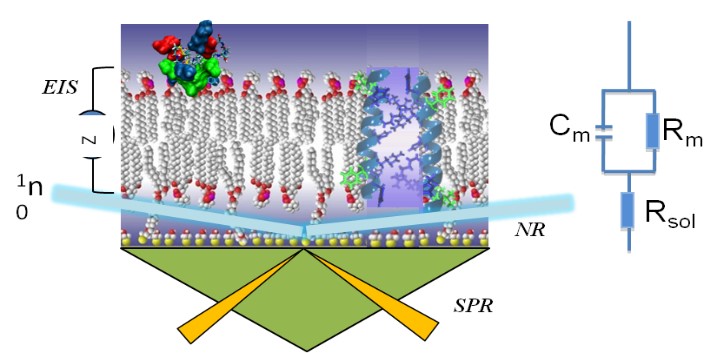
Membrane-active peptides and lipophilic drugs (e.g. antimicrobial peptides, toxins, hormones, NSAIDs) work by binding to and entering bilayer environments, causing membrane deformations and changes in the electrical properties of the bilayer. For many pore-forming toxins and antimicrobial peptides, interactions with the bilayer lipids is a key event that drives folding into functional secondary structures and assembly of peptide monomers into trans-membrane pores. Neutron Diffraction and Reflectometry techniques can provide unique structural information on the position and distribution of these molecules in lipid bilayers, while Electrical Impedance Spectroscopy (EIS) can exquisitely capture the onset of membrane permeabilization through such protein pores or channels. Dr. Mihailescu seeks to understand what properties of antimicrobial peptides make them potent antibiotics by coupling structural and functional observations of their behavior in membranes. In a broader collaborative effort with NIST laboratories, Mihailescu's group at IBBR is developing high-throughput biophysical measurement techniques to provide multimodal data inputs for Machine Learning predictive models, for the discovery of MAPs with desired properties, within the project titled: "ROADMAP: Reflectometry-driven Optimization And Discovery of Membrane Active Peptides". (https://www.nist.gov/programs-projects/roadmap-reflectometry-driven-optimization-and-discovery-membrane-active-peptides)
OTHER RESEARCH
Measurements of Membrane Protein Structures and Interactions
The Mihailescu laboratory is also utilizing their unique experimental expertise in neutron and X-ray scattering methods, surface-sensitive techniques, and computational approaches to solve challenging problems in the area of membrane protein research. MPs are critically important to the pharmaceutical industry, as they are the target of half of all drugs; 33% target G-protein-coupled receptors and 18% target membrane ion channels (Santos et al. 2017. Nat. Rev. Drug. Discov.). Macroscopic observations from cell-based assays and empirical approaches in drug discovery must be informed by molecular level information obtained with structural techniques.
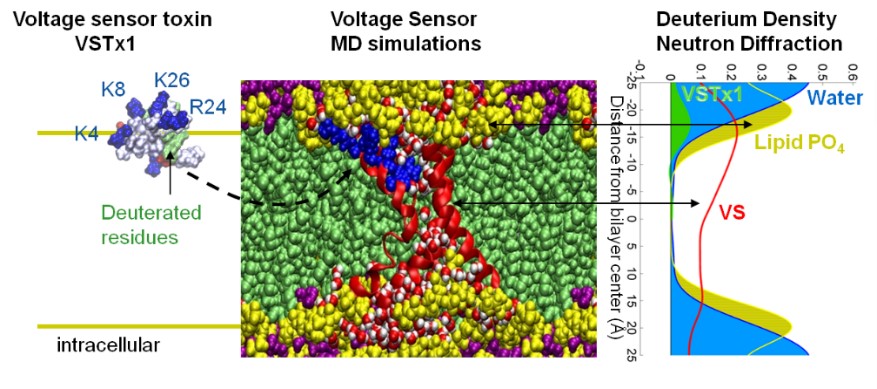
The lipid membrane constitutes not only the environment for MP folding and stability, but also a mediator for ligand-receptor interactions. These structures and interactions, as well as associated membrane deformations that accommodate such interactions, can be uniquely inferred from neutron diffraction patterns of deuterium-labeled samples. To this end, the lab is exploring methods for functional reconstitution of peptide ligands, and membrane proteins in conjunction with deuterium labeling. The diffraction measurements can be complemented computationally with molecular dynamics (MD) simulations. For instance, diffraction data led to information about the conformations, and interactions that ion channel proteins and gating-modifier toxins from tarantula venom (e.g. VSTx1) establish in the bilayer environment. This research helped to resolve controversial issues regarding mechanistic models of voltage-gated ion channel activation.