
Profile

Frank Delaglio
Our group develops computational methods and working software for IBBR’s programs to develop metrology and standards in support of biomanufacturing of monoclonal antibodies (mAbs) and other therapies, and our group also supports basic research in structural biology for both IBBR and for the global NMR community. Motivations for this work are manifold and powerful. The therapeutic protein market has global sales exceeding $340 billion, and most of this is manufactured using CHO cells, providing many opportunities to profit from NMR methods for structure characterization and metabolomics. Protein therapeutics must retain their three dimensional structure in order to be safe and effective, and work at IBBR has demonstrated that NMR can characterize structural stability of mAb therapies in their original formulation. While a molecule’s structure determines its function, performing that function invariably requires molecular change, making NMR’s unique ability to measure dynamics at high resolution and at many timescales invaluable. Work at IBBR shows that NMR dynamics can explain the stabilizing and destabilizing effects of different formulations, helping to put lengthy trial-and-error formulation studies on a rational footing. Nucleic acid drugs and vaccines have seen massive growth, and offer the promise of making new therapies on-demand, including for targets “undrugable” by other modalities. However, there are still many unknown aspects of nucleic acid structure and dynamics, especially for hybrid DNA/RNA constructs and chemically modified bases often employed in therapies; these too can be informed by NMR. IBBR investigators have demonstrated that water relaxometry (wNMR) can test the authenticity of injectable pharmaceutics non-invasively, by measurements made directly on vials and pre-filled syringes. All of these applications need computational workflows.
As a platform for this computational work, our group develops and distributes the NMRPipe software system (http://www.ibbr.umd.edu/nmrpipe), which has been cited over 15,000 times and has been used to help generate one third of the protein structures ever measured by NMR.
 Our group's areas of interest include multidimensional spectral processing and analysis, chemometrics and machine learning, data visualization, and NMR homology approaches to biomolecular structure determination. Group leader Delaglio has made more than 200 lectures and tutorials in 15 countries, including 20+ years as advanced course instructor for the European Molecular Biology Organization (EMBO) and the UCONN Center for Biomolecular NMR Data Processing and Analysis (nmrbox.org). He shared a 2022 Department of Commerce Silver Medal for contributions to biomanufacuring, and was awarded the 2024 Americal Chemical Society Award in Chemical Instrumentation.
CURRENT RESEARCH
Bioreactor Monitoring by Low Field NMR
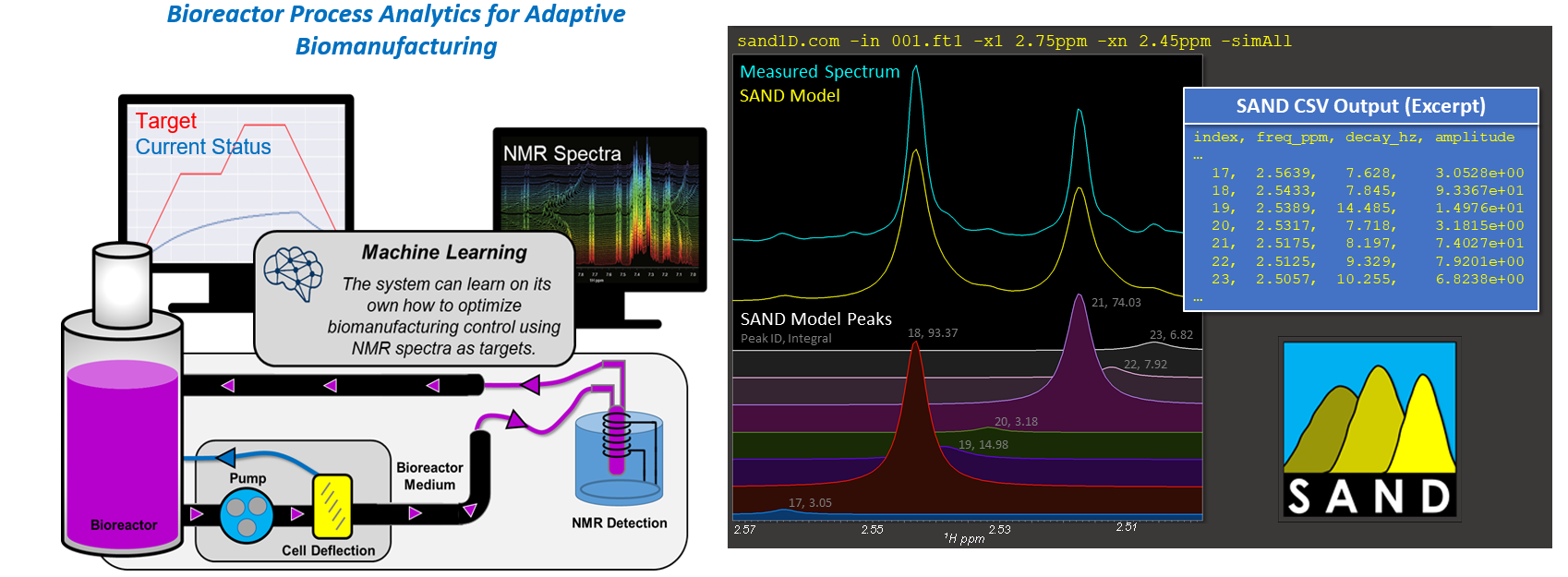
Protein drugs are manufactured by live cells using media with 50 or more components, and employing specially engineered cell lines. Small variations in materials or conditions can cause substantial changes to the safety, efficacy, and yield of the intended products, making the ability to chemically characterize an ongoing bioreaction a critical measurement need. In spite of the medical and commercial importance of biomanufacturing, process analytics for bioreactors are ad hoc, and limited in detail and measurement frequency. Using the NISTCHO live cell reference material as a model system, our goal is to establish new instrumentation, protocols, and data handling for standardized bioreactor process analytics based upon nuclear magnetic resonance (NMR) detectors, which can provide comprehensive molecular information in real time, non-destructively, and with similar sample handling and measurement protocols for a bioreaction at any scale. Employing NMR as configurable, non-destructive “universal detector” for a bioreactor has exceptional potential to revolutionize many types of biomanufacturing. The rich chemical insight afforded by NMR also supports another intriguing goal, to build a system with adjustment of the bioreaction parameters in real time under software control (so called ‘adaptive control’), in response to the enhanced information content unique to NMR measurements. Using Artificial Intelligence methods for process control would allow development of a system that can determine on its own how to establish homeostasis for continuous biomanufacturing, or to optimize other details, such as minimizing reaction time or maximizing yield, using NMR spectra as targets.
Machine Learning Approaches to Spectral Analysis
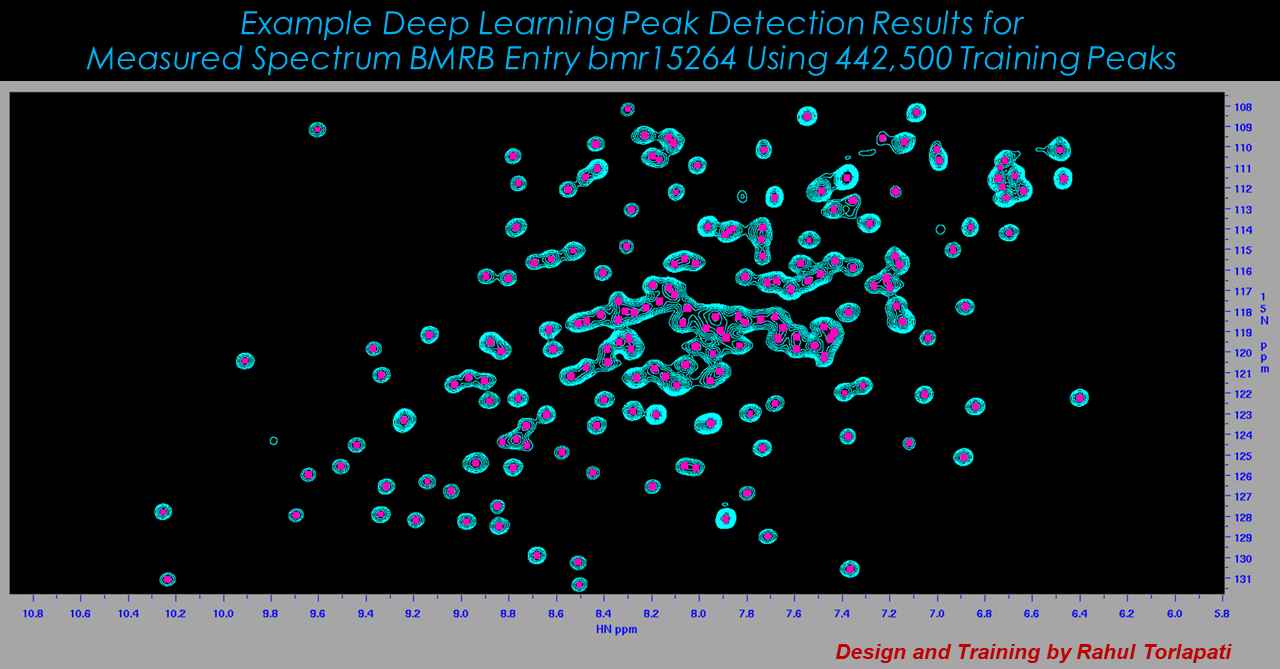
While workflows vary, a common aspect of most any NMR analysis is to identify spectral features ("peaks"). While automated software can do most of this work, a typical analysis requires that peak detection is curated by an expert. This is subjective and can be extremely time-consuming, since individual spectra can have hundreds or thousands of peaks, and applications can involve dozens or hundreds of spectra. Other requirements common to many NMR workflows include identifying peaks that are related to each other, following changes in peaks over a collection of related spectra such as a time series, or gauging the similarity between two spectra. In all of these cases, a human analyst makes high-quality decisions by inspecting spectral graphics in the form of 1D plots and 2D contour plots. The Delaglio Group explores application of computer vision methods to these analysis tasks.
Publications
- DC+: A web server for the analysis of residual dipolar couplings.
- Metabolite Fraction Libraries for Quantitative NMR Metabolomics.
- Unraveling the Stereochemical Complexity of Phosphorothioate-Modified Oligonucleotides Using Analytical Technologies.
- Metabolite Fraction Libraries for Quantitative NMR Metabolomics.
- Multiplatform Benchtop NMR Interlaboratory Study of Model Liquid Dosage Forms of Pharmaceutical Products.
- Reducing the measurement time of exact NOEs by non-uniform sampling.
- Principal component analysis for automated classification of 2D spectra and interferograms of protein therapeutics: influence of noise, reconstruction details, and data preparation.
- Assessment of the Higher-Order Structure of Formulated Monoclonal Antibody Therapeutics by 2D Methyl Correlated NMR and Principal Component Analysis.
- Comparative Analysis of One-Dimensional Protein Fingerprint by Line Shape Enhancement and Two-Dimensional 1H,13C Methyl NMR Methods for Characterization of the Higher Order Structure of IgG1 Monoclonal Antibodies.
- Best Practices in Utilization of 2D-NMR Spectral Data as the Input for Chemometric Analysis in Biopharmaceutical Applications.
- Chemometric Outlier Classification of 2D-NMR Spectra to Enable Higher Order Structure Characterization of Protein Therapeutics.
- Enabling adoption of 2D-NMR for the higher order structure assessment of monoclonal antibody therapeutics.
- Selective suppression of excipient signals in 2D 1H-13C methyl spectra of biopharmaceutical products.
- Non-Uniform Sampling for All: More NMR Spectral Quality, Less Measurement Time.
- Nonuniform sampling in multidimensional NMR for improving spectral sensitivity.
- Solution structure of (gamma)S-crystallin by molecular fragment replacement NMR.
- Molecular fragment replacement approach to protein structure determination by chemical shift and dipolar homology database mining.
- The utility of residual dipolar couplings in detecting motion in carbohydrates: application to sucrose.